
Finding Carteret Resident Records
A productive Carteret resident search begins with the connection being checked. An address can lead to the Carteret assessment card, a block and lot, and then a recorded deed. A name can lead to a court party search, a voter-status check, a historic directory, or a filing record. Those results are not interchangeable. A deed records a party to a transfer; it does not prove current occupancy. A voter-status result is dated election information, not a full household list. Keep the exact spelling, municipality label, source URL, and date checked with every result.
No official borough-wide online directory was located. The practical route combines county indexes, state portals, the Carteret Municipal Clerk, and historical repositories. When a record is not indexed, request an existing record or index from the right custodian rather than assuming it does not exist.
- Normalize the name or address, then confirm the record is in Carteret rather than relying on a mailing label alone.
- Use the Carteret assessor search to capture district, block, lot, and qualifier for a parcel.
- Search the Middlesex County land index by party, town, lot and block, or book and page.
- Compare a person-centered result through the New Jersey voter or court route when the result category fits.
- For an older household, search Carteret and Roosevelt in directory reels, newspapers, and archive catalogs.
Carteret Records Offices Behind Searches
Carteret records are held at more than one level of government. The borough clerk holds municipal governing and archival material. The borough assessor connects a property to local assessment identifiers. Middlesex County records deeds and related instruments, while state systems host the court and voter routes. A search works best when it starts with the custodian that created the record. Street-by-street parcel work belongs on the Carteret street directory page, where the address chain is handled in more detail.
Middlesex County Clerk, Land Records
County Administration Building
75 Bayard Street, New Brunswick, NJ 08901
Carteret Finance and Tax
Thomas J. Deverin Center
100 Cooke Avenue, Carteret, NJ 07008
732-541-3820 ext. 3818
Middlesex Board of Elections
26 Kennedy Boulevard, Suite B
East Brunswick, NJ 08816
732-745-3471
New Brunswick is the county seat. County filing location, court venue, and a Carteret mailing address can differ, so record the stated jurisdiction before connecting two results.
Carteret Parcel Search Fields
The Carteret assessment search is the fastest way to turn a street address into local property identifiers. Its sequence starts with database, county, district, search-format, output-format, and items-per-page selectors. The searchable criteria are Location, Owner Name, Block, Lot, and Qualifier. Save the date on the card. Carteret's revaluation took effect October 1, 2024 for 2025 taxes, so a present card and an earlier assessment can differ without showing a transfer.
| Field | Use in Carteret | Format note |
|---|---|---|
| Location | Starts with a street address | Use the municipal address where known |
| Owner Name | Finds assessment parties | Compare against the record year |
| Block and Lot | Connects tax-map and deed work | Capture the qualifier if shown |
| Qualifier | Distinguishes a parcel segment | Keep it with block and lot |
Carteret's revaluation portal explains the property-card route. An assessment card reflects assessment work, inspections, exterior review, permits, and sales data. It is not a deed, survey, or proof that a particular person lives there. Record the assessment year with the result.
The Carteret assessment search is shown below. The card route is most useful for identifying a parcel before moving to the county deed index.
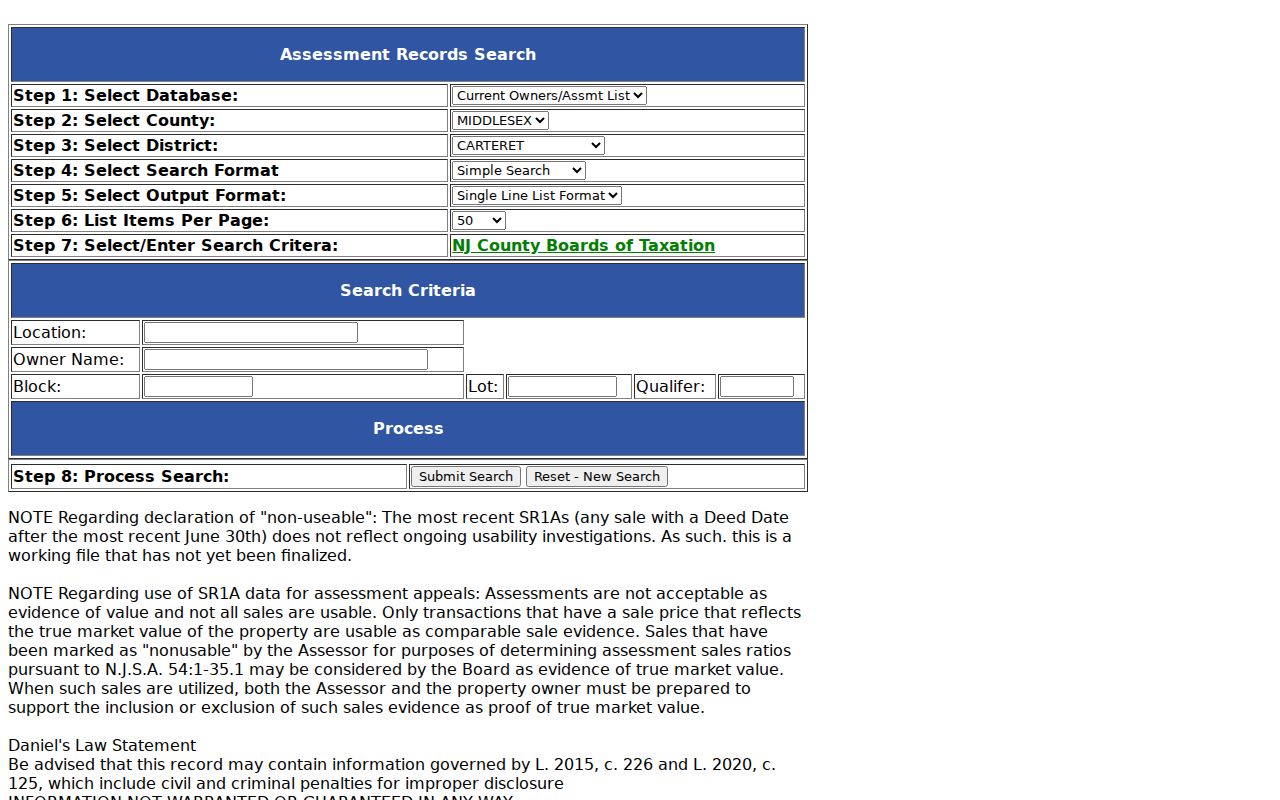
Use these identifiers as a dated research note, then verify legal title history through the recorder.
Current Carteret Resident Directory Sources
Current Carteret directories are separate record sets rather than one roll. Each has a keeper, a time frame, and a limit on what it can show. The county deed index is a title trail, the assessor card is an assessment snapshot, and voter status is a narrow election result. The right source depends on whether the question concerns a parcel, a filing, a registered voter, or an old household.
| Record source | What it can confirm | Custodian | Access route |
|---|---|---|---|
| Carteret assessment card | Assessment party, parcel identifiers, and assessment facts | Carteret Finance and Tax | Property portal |
| Land-record index | Parties to deeds, mortgages, liens, and related instruments | Middlesex County Clerk | Public browser and clerk copies |
| Voter status | Registration status for a matching voter | New Jersey elections | State status check |
| Civil case jacket | Named party, venue, docket, caption, and filing date | New Jersey Courts | Public case route |
| Historic directory reels | Point-in-time household and address listings | NJ State Library and repositories | Reading room or collection access |
A current-name question may need several matches. The Carteret resident lookup path concentrates on checking one person across separate categories without treating them as one profile. The official voter route requires careful matching of first name, last name, date of birth, and any relevant middle initial or former surname.
New Jersey's voter status check is pictured below. Exact spelling, spaces, hyphens, and name changes can alter a result, and protected addresses must remain protected.
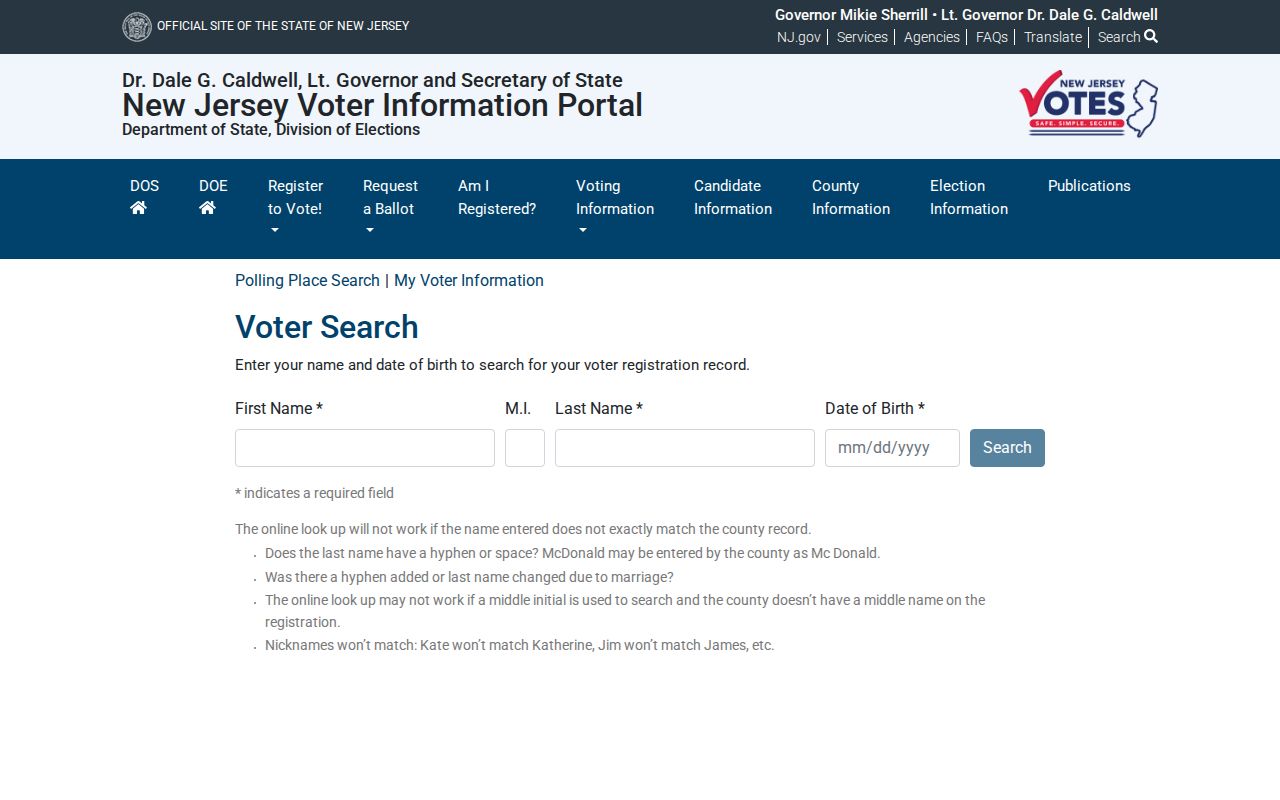
The election route is a verification step, not a substitute for a current household directory.
Carteret 07008 Geography Limits
Carteret's standard postal ZIP is 07008, but a ZIP Code is a delivery route, not proof of borough boundaries or parcel jurisdiction. The USPS address route can verify mail service. Census ZCTAs are generalized statistical areas built from blocks. The municipal tax district, county GIS layer, and deed municipality answer different geographic questions.
When a name search returns a Carteret mailing address, confirm the parcel municipality and tax district before treating the record as local. That check matters near jurisdictional edges and for older files, which may use surrounding place names. It also prevents a ZIP filter from replacing a property or government-boundary check.
- Parcel
- A defined property unit used with block, lot, and sometimes qualifier identifiers.
- Index
- A finding aid that points to a record rather than replacing its image or certified copy.
- Criss-cross directory
- A reverse directory arranged by address rather than by a person's name.
- ZCTA
- A Census approximation of ZIP geography, not a USPS or municipal boundary.
Note: Record the ZIP as one address attribute, then preserve the municipal and parcel identifiers that the source supplies.
Roosevelt Names in Carteret Directories
Carteret was formerly called Roosevelt and changed names in 1906. That fact changes how an older resident directory is searched. A family, street, or municipal item may be cataloged under Roosevelt even though a modern database calls the same place Carteret. The local newspaper record follows the same pattern: Roosevelt News ran from 1908 to 1922, and Carteret News followed from 1922 to 1945, with later title variations.
For a historical search, run both place names with the surname, street, and year. Do not assume that a hit in a regional title belongs to Carteret until the address and source context agree. The State Library reels also group Carteret with Perth Amboy, Rahway, Woodbridge, Chrome, Sewaren, Port Reading, Fords, and Keasbey in different years.
This local naming switch is a records-history clue, not an address crosswalk. No comprehensive official street-renumbering or renaming list was located, so compare a tax map, deed description, and original directory spelling when an old address does not resolve.
Middlesex Deeds for Carteret Names
The Middlesex land-record browser offers property-type, party-name, town, lot-block, map, instrument, book-page, and parcel-ID modes. Party names use a last-name, first-name style without a comma, such as Smith Al. Adding a town, date range, document type, lot, block, map, or book and page reduces same-name matches. Results identify instrument number, book and page, and document detail, with image controls for available records.
A deed trail becomes stronger when the preceding reference is followed. The County Clerk describes using the deed's Being Clause, the part that cites the prior conveyance, to move back through a title chain. Save the instrument number and book and page before opening a document. For a certified deed copy, the county FAQ states $2 per page plus a $10 certification charge, available by written request or in person.
Online coverage needs a caution. The legacy notice gives deeds from January 1, 1929 forward, while county material reports deed images back to 1923. For the 1923 to 1928 interval, verify availability with the clerk or public search room instead of assuming complete web access.
Carteret Court Lookup Lanes
Court records are split by venue and case type. Carteret Municipal Court at 230 Roosevelt Avenue handles its municipal jurisdiction and points ticket users to NJMCDirect. The statewide court hub separates civil and foreclosure, criminal, criminal judgments, judgment liens, Tax Court, and municipal searches. A ticket number is not a substitute for a Superior Court docket, and a party name should be checked against venue, caption, and initiation date.
The public Civil Case Jacket lets a user choose an individual or business party search. Individual searches require last and first name, with middle initial optional. Short names of two or fewer characters match exactly; longer terms broaden results. The result columns include name, venue, docket number, case caption, and case initiation date. A docket can lead to a case jacket, but online access does not guarantee every filing image or text.
New Jersey Courts' public case hub is pictured below. Match the court category before drawing any conclusion from a name result.
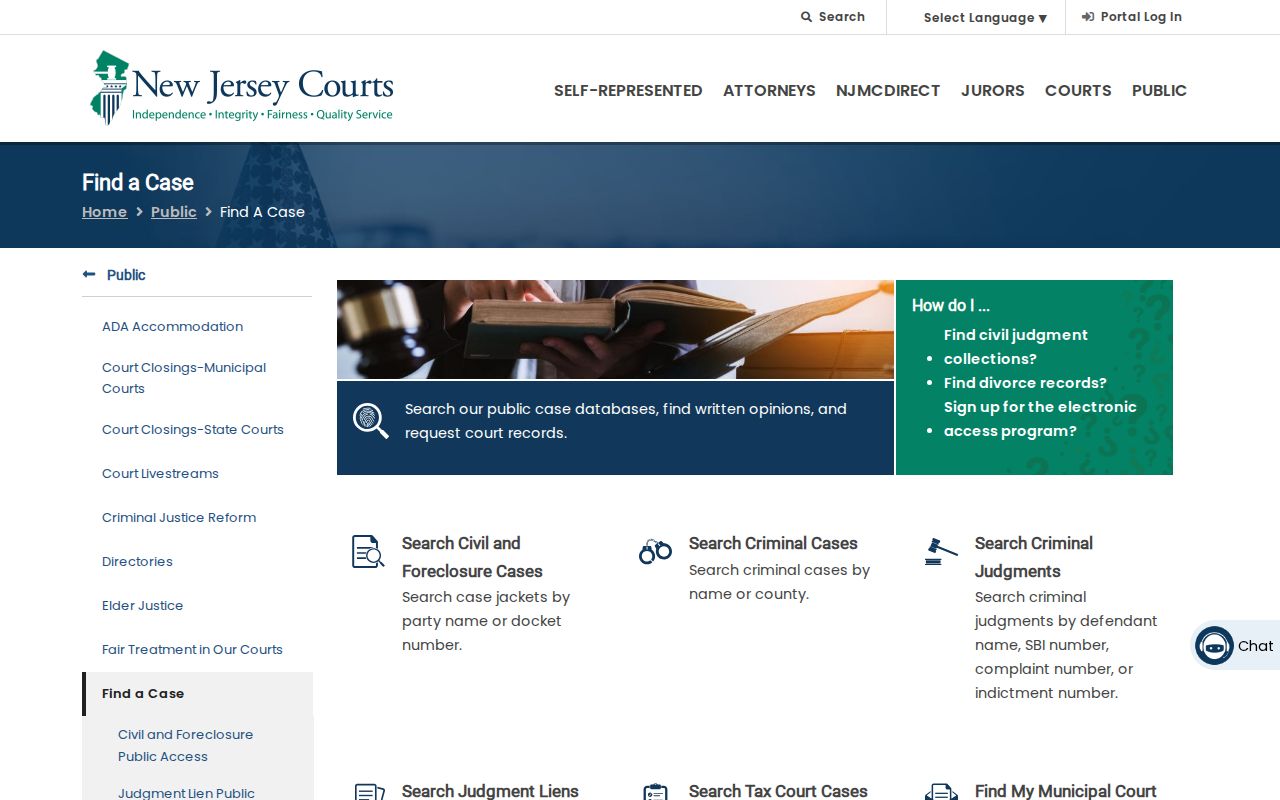
A docket confirms a case record, not a current address or a complete account of a person.
Carteret Vital Record Access
Carteret Health Department is the local route for vital-record copies, while the New Jersey vital-records hub sets the broader rules and forms. Certified copies require an eligible relationship, identification, and relationship evidence. Genealogy copies follow separate age thresholds and fee rules. An adoption record has additional restrictions and is not an ordinary public record.
For genealogy requests, the state describes thresholds for births older than 80 years, marriages older than 50 years, and deaths older than 40 years, with the stated cutoff years in its instructions. Records over 100 years go to the State Archives. The first copy, certification, or no-record response is listed at $25, with separate prices for eligible additional copies and genealogy options. The state estimates mail genealogy processing at 10 to 12 weeks.
New Jersey's public vital forms index is shown below. Use the form and eligibility instructions for the event type rather than sending a general name request.
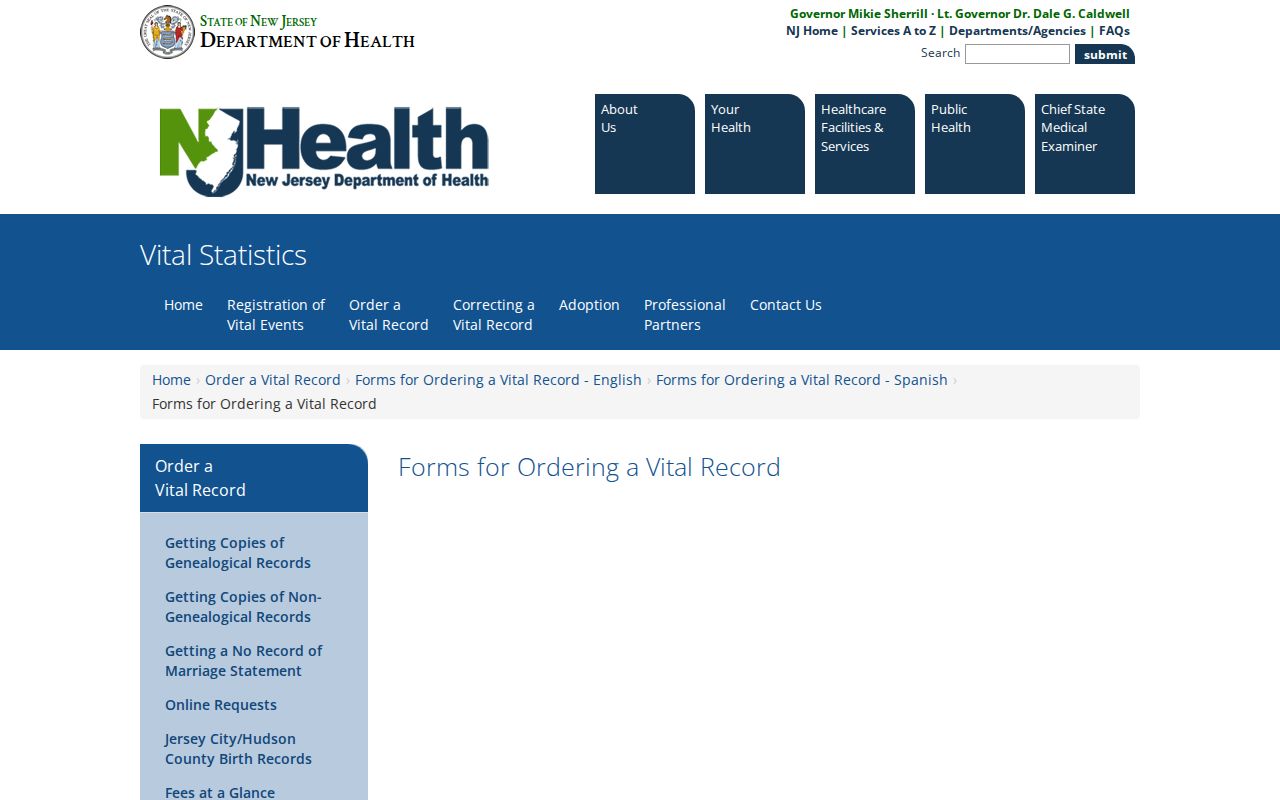
Vital records can establish a defined event. They should not be used to recreate information protected by eligibility or confidentiality rules.
Historical Carteret Resident Directories
The historical Carteret directory shelf is regional. The New Jersey State Library guide records the 1904 Wand's City of Rahway, Carteret, Port Reading, Sewaren and Woodbridge Directory on Rahway Segment IV Reel 24. It also identifies a 1906 Carteret, Chrome and Port Reading directory. Richmond directories covering Carteret appear under Perth Amboy for 1912 through 1916 on Segment IV Reel 18 and for 1917 and 1918 on Reel 19.
Those years are separate snapshots, not a continuous household history. Read the actual entry for the street, initials, occupation field, and place name. A directory address may be a business, boarding location, or earlier address. Pair it with a deed, census schedule, newspaper notice, vital record, or probate file before making a stronger family-history claim. The full collection approach is on the Carteret city directory page.
The Carteret Public Library, Historical Committee, Middlesex Kler Reading Room, State Library, and State Archives provide different access channels. Ask for the collection title, year, reel or call number, surname, street, and whether a visit, appointment, or digitized item is available.
Carteret OPRA Request Route
Some local records have no public search screen. No public Carteret building-permit index was located, although the Construction Office has building, plumbing, electrical, fire-subcode, inspection, zoning, Planning Board, and Zoning Board routes. For an existing permit, final inspection, certificate, zoning determination, plan file, or municipal index, use the Carteret form under the New Jersey Open Public Records Act, N.J.S.A. 47:1A-1 et seq.
A specific request gives the custodian a usable record trail: street address, block and lot, date range, record category, and known agency. The borough form offers pickup, mail, on-site inspection, fax, and email preferences. It includes a request-information field, a maximum authorization cost, and agency disposition fields. The general response target is seven business days once the custodian receives a sufficient written request, subject to the act's rules.
Construction contacts can identify whether a record belongs with construction, zoning, planning, or the clerk. The borough's Planning materials point to a Laserfiche repository, but its access was not available in the research capture. Ask the responsible office about a specific file rather than assuming it is online.
Carteret Privacy Stops Matter
Redactions are part of an accurate Carteret residents directory. New Jersey's Address Confidentiality Program can provide a substitute address. Daniel's Law can require state, county, and local sites to shield covered home addresses and unpublished telephone numbers. NJGIN and other public property layers may also redact an owner name. A missing detail can be a lawful protection, not a gap to solve through another record.
Use public records for lawful personal research only. Do not use a name, map, address, or record trail to stalk, threaten, harass, or harm anyone, and do not reconstruct protected details.
Use the published custodian or privacy-program route for a correction or removal question. Keep sensitive identifiers, signatures, full birth dates, certificate numbers, and protected addresses out of research notes. A reliable search preserves a source's limits as carefully as it preserves a match.
Note: A redaction ends the cross-reference chain; a second source should not be used to infer the field the first custodian lawfully withheld.
Carteret Waterfront Record Trails
Carteret's waterfront history adds a local records layer that ordinary name searching can miss. The borough's December 2025 ferry-terminal announcement describes a former DuPont Arthur Kill brownfield site, a four-story multimodal terminal, public grants, and a projected completion in late 2027 or early 2028. Those project facts are context, not a person record.
For a property or civic-history question near the Port District, Riverwalk, marina, or Arthur Kill waterfront, search the project name and parcel through planning materials, contracts, grants, easements, deed instruments, environmental records, and public-meeting minutes. Preserve the announcement date and any projected date. Later official records, not an announcement, establish the operative legal fact.