
Carteret Previous Residents by Era
The best Carteret previous-resident search begins by placing an address in a time range. Recorded land documents are strongest for a title sequence. Assessment records help identify the parcel, block, lot, qualifier, and a year to compare. Regional city directories and newspapers add household clues, while census and archive material can expand a family trail. Do not merge these descriptions. A person listed in a directory is not automatically the owner, and an owner in a deed is not automatically the occupant.
| Source | Years it covers | Where held | What it shows |
|---|---|---|---|
| Middlesex land-record search | Deeds 1929-present in the legacy notice; county reporting also cites images back to 1923 | Middlesex County Clerk online portal and clerk assistance | Recorded instruments, parties, book/page, and legal-description trail |
| Carteret assessment and MOD-IV data | Current Carteret card; MOD-IV 1989 through latest annual file | Carteret property search and Rutgers MOD-IV | Assessment year, parcel identifiers, classification, and property context |
| Regional directory runs | 1904, 1906, and 1912-1918 verified runs | New Jersey State Library guide and repository reels | Dated listings, street lines, and printed place labels |
| State Archives census and civil holdings | State census 1855-1915; federal schedules 1820-1890 in listed holdings | New Jersey State Archives | Historic household and county context |
| Municipal permit and planning files | Varies; no public Carteret permit index located | Construction Office or the proper custodian through OPRA | Specified permit, inspection, zoning, or planning records |
Start with the period that has the most reliable identifying detail. For a newer Carteret parcel, that is usually the assessment card and deed trail. For an early household question, the State Library reel and archive route may come first. Preserve the source date and exact result label at each step, including a negative result such as no exact party match in the searched date range.
Note: An address timeline should label each result as owner, listed person, official record party, or historical lead rather than assume occupancy.
Carteret Previous Residents in the Deed Chain
Ownership research for Carteret begins with the parcel, then moves to the Middlesex County Clerk's recorded documents. The Carteret property-card route accepts Location, Owner Name, Block, Lot, and Qualifier after its database and search-format selections. Those fields are useful identifiers, but an assessment card is not a deed, survey, or proof of occupancy. Carry the municipality, district, block, lot, qualifier, instrument number, book/page, and parcel ID forward when they appear. The deed record is the better source for a chain of title because it records the instrument and legal description.
- Look up the Carteret parcel by address, then copy its block, lot, qualifier, assessment year, and displayed owner name exactly as returned.
- Search the Middlesex County land-record portal by lot/block, party name, instrument number, or book and page. For party searches, the county instruction uses a last-name, first-name style without commas.
- Record the instrument number, book/page, document detail, recording date, parties, and legal description before opening or printing an image.
- Read the deed's Being Clause, which points to the prior deed reference. Search the seller as a grantee in the earlier transfer, then repeat the sequence backward.
- For an older book, unclear index entry, or certified copy, contact the County Clerk. The county FAQ lists written or in-person certified deed copies at $2 per page plus $10 certification.
- Grantor and grantee
- The grantor transfers an interest in a deed. The grantee receives that interest. Those roles change with each recorded transfer.
- Chain of title
- A dated sequence of recorded transfers for the same property. It is evidence of title sequence, not proof that every owner lived there.
- Legal description
- The parcel description in a recorded document. It is often more stable than a street address when a name, street, or parcel use changes.
Carteret Previous Residents and Deed Coverage
The online deed start date has an important Carteret access caveat. The legacy land-record notice says deeds run from January 1, 1929 to the present, while county news reports deed images back to 1923. Treat 1923 through 1928 as a range to verify with the County Clerk or public search room, not as a guaranteed complete online run. Mortgages begin in 1950 in the legacy notice, and other document types begin in 1958. A careful previous-residents trail records which coverage statement was used and whether the result came from an index, image, book, or clerk response.
The Middlesex County public land-record search is the source of the deed-index view below.
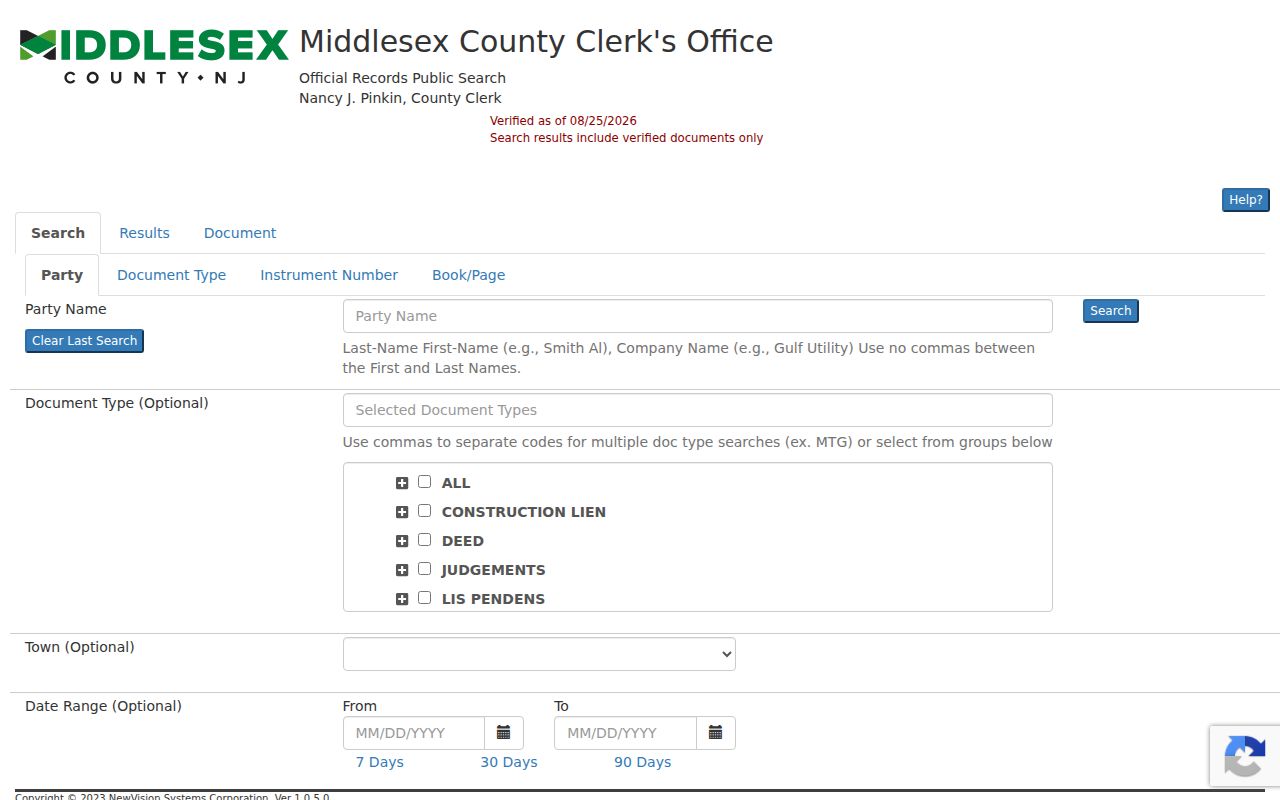
The portal offers property-type, name, town, lot/block, map, instrument, book/page, and parcel-ID modes. Result rows identify an instrument number, book/page, document detail, and image-viewer controls. Save those values even when a document image is available, because they make an in-person or written follow-up easier to reproduce.
Note: The 1923-to-1928 discrepancy is a useful research finding, not a reason to claim that every older Carteret deed is online.
Carteret Previous Residents Under Roosevelt
Historic address work has a Carteret naming trap. The borough was called Roosevelt before its 1906 name change, so old directories, newspapers, property descriptions, and municipal material can use Roosevelt. Search both place names with the street, surname, institution, and date. The Carteret Historical Committee identifies The Roosevelt News from 1908 through 1922, then Carteret News from 1922 through 1945, with later title variations. A search for only the current borough name can lose a relevant historical report.
The name change does not mean every Roosevelt or regional hit belongs to the same address. Confirm the street spelling, house number where shown, source title, and date. Historic maps, deed descriptions, street intersections, and parcel IDs are more reliable than a normalized address string alone, particularly where waterfront and industrial redevelopment has changed parcel use. No official Carteret street-renumbering crosswalk was located, so state that limitation instead of inventing a conversion.
Carteret Previous Residents as a Dated Timeline
Build the Carteret trail in layers. The process is address to assessment identifiers, assessment identifiers to a recorded deed, deed reference to earlier deed, then historic directory or newspaper to a dated listing. A deed and official assessment or map are primary for their own subjects. A directory or newspaper is contemporaneous secondary evidence. Historical recollection is a lead or context item. That simple labeling prevents a name-only result from becoming an unsupported claim about a former household.
| Title trail | Recorded deed, instrument number, book/page, legal description, and the Being Clause reference. |
|---|---|
| Parcel context | Assessment year, block, lot, qualifier, tax map, and GIS location, each with the date checked. |
| Household lead | Directory or newspaper title, year, printed place name, address line, and page or image reference. |
| Family context | Census, probate, vital, cemetery, or archive record, subject to its access rules and date. |
| Uncertainty | Keep a no-match, name variant, redaction, or access limitation in the research note. |
Recent Carteret ferry, marina, and waterfront projects can add easement, planning, grant, and public-meeting records to an address history. Search project names with parcel numbers if an older street address seems to disappear or change use. Those project records help explain a changing parcel. They do not identify a private household.
Carteret Past Households in Directories
Deeds describe a title trail, but past residents need a household layer. Verified regional directory runs include the 1904 Wand's directory, a 1906 Carteret, Chrome & Port Reading directory, and Richmond runs for 1912 through 1918. Pair each listing with the closest available census or State Archives source. Keep the original wording: “listed at” an address is different from “recorded as owner.” The historical collections themselves, including their regional catalog titles and reels, are described on the Carteret city directory page.
- Write the address, source year, place label, and name as printed in the directory or newspaper.
- Search the next surviving volume with spelling variants, Roosevelt and Carteret terms, and the exact street.
- Pair the dated listing with a census schedule, State Archives source, or FamilySearch discovery result that fits the period.
- Use an obituary, cemetery notice, probate record, or vital record as a relationship lead, then cross-check it with a contemporaneous source.
For local context, Carteret Public Library offers digital resources and FamilySearch affiliate discovery, while the Historical Committee, Middlesex Kler Reading Room, Rutgers collections, and State Archives can provide photographs, newspaper runs, finding aids, and historic records. Ask each repository for the collection title, year, street, surname, and access method rather than assuming a complete digital index.
Lawful use. Carteret house-history research is for family history, estate questions, and personal curiosity. Do not use a historic listing, parcel record, or address trail to track, harass, or harm a living person.
Carteret Previous Residents Without an Index
No public Carteret building-permit index was located. That makes a narrow records request the fallback for a known address, not an invitation to request every document about a person. The Construction Office provides building, plumbing, electrical, fire-subcode, inspection, zoning, Planning Board, and Zoning Board contacts. If the custodian is uncertain, ask the Municipal Clerk where a specified permit or planning record is held. Include the street address, block and lot, permit category, and date range.
Use the borough's OPRA form for a municipal request. It supports pickup, mail, on-site inspection, fax, and email delivery choices when the agency can provide them and maintain record integrity. For a current identifiable record, New Jersey OPRA, N.J.S.A. 47:1A-1 et seq., generally sets a seven-business-day response target after receipt by the correct custodian. Preserve the signed request, delivery proof, clarification, response date, cost, and any redaction reason.
Carteret Previous Residents Result Limits
Previous-residents work is strongest when it separates recorded owner, listed person, business, mailing recipient, official, and family relationship. An assessment card can lag a transfer. A newspaper can contain a typo or a temporary address. A court caption can omit filing text. A voter status result is not a current-occupancy guarantee, and protected or substitute addresses must stay protected. Do not publish full dates of birth, certificate numbers, signatures, ID numbers, or protected addresses found while checking a historical trail.
When a document is missing, note the access channel tried: online index, image viewer, County Clerk, municipal custodian, library, reading room, archive, or a narrowly tailored follow-up. That record of work is more useful than treating silence as proof that a Carteret record never existed. It also keeps a future family or house-history search focused on the source most likely to answer the next dated question.
Note: A careful Carteret address history records source limits alongside matches, especially when catalog terms, place names, and online coverage change.